


Investment Management - Second Quarter 2026
Position and Possession
“Sport has the power to change the world. It has the power to inspire. It has the power to unite people in a way that little else does.” – Nelson Mandela
On North American soil for the first time in 32 years, much of the world’s attention has turned to the 2026 FIFA World Cup. While markets, economies, and geopolitics often dominate the headlines, the tournament offers a unique perspective. Every four years, nations with vastly diverse cultures, histories, and political systems come together through a shared passion for competition. Fans travel thousands of miles to support their teams, strangers become friends for ninety minutes (plus stoppage time), and rivalries coexist alongside mutual respect.
For investors, there is a useful lesson in this global gathering. Financial markets are often portrayed as a battleground of winners versus losers, bulls versus bears, growth versus value, domestic versus international, and so on. Yet long-term prosperity has historically been driven by cooperation, innovation, diversity, and the collective efforts of businesses and consumers across the globe. The World Cup reminds us that despite disagreements and uncertainty, of which there is plenty these days, people generally move forward together.
Much like last year, the second quarter of 2026 presented no shortage of uncertainty. Geopolitical tensions in the Middle East intensified, inflation remained stubbornly above central bank targets, leadership changed at the Federal Reserve (Fed), and investors continued to debate whether the artificial intelligence (AI) boom is sustainable. Despite these concerns, markets demonstrated continued resilience and corporate fundamentals remained largely supportive of higher asset prices.
Key Takeaways from the Second Quarter
- Geopolitical easing: Signs of a potential end to the Iran conflict helped lift sentiment and reduce risk premiums
- Fed leadership shift: Markets adjust to the transition from Powell to Warsh, adding uncertainty on the future path of interest rates
- Earnings and AI tailwind: Strong corporate earnings and continued momentum in AI-related sectors helped drive equity gains
Corner Kick – Markets Rally into the Break
Equity markets staged a sharp rebound in the second quarter after a downbeat start to the year, with the S&P 500 index surging 15.2%, the strongest quarter since the recovery from the COVID-19 pandemic lows in 2020.i The index repeatedly pushed into record territory during the period, closing just 1.5% away from a new all-time high, thanks to strong fundamentals, increasing investor confidence, and market momentum. Medium and small capitalization companies – represented by the S&P 400 and S&P 600 – also fared well, with returns of 14.4% and 19.7%, respectively.
International markets were more divergent, with developed markets (as tracked by the MSCI EAFE index) advancing 11.1% while emerging markets (MSCI EM), heavily dominated by three Asian semiconductor companies, rose an astounding 24%. Consumers and companies are spending, corporate earnings are soaring on strong revenue growth and higher profit margins, and the economy appears to be on stable ground, with odds of a recession in the U.S. over the next 12 months falling to just 15%.ii
Performanceiii for various indices for the three-month (not annualized), one-year, three-year, and five-year periods appears below:
Bond Indices
Dates | ICE BofA 1-5 Yr. | ICE BofA 1-10 Yr. | ICE BofA 1-12 Yr. Muni |
|---|---|---|---|
3/31/26 - 6/30/26 | 0.88% | 1.03% | 1.33% |
6/30/25 - 6/30/26 | 3.92% | 4.21% | 4.40% |
6/30/23 - 6/30/26 | 5.78% | 6.04% | 3.50% |
6/30/21 - 6/30/26 | 2.39% | 1.89% | 1.37% |
Equity Indices
Dates | Dow Jones Ind. Avg. | NASDAQ Composite | S&P 500 (Large) | S&P 400 (Medium) | S&P 600 (Small) | MSCI EAFE (Int'l) |
|---|---|---|---|---|---|---|
3/31/26 - 6/30/26 | 13.38% | 21.60% | 15.20% | 14.47% | 19.70% | 11.08% |
6/30/25 - 6/30/26 | 20.65% | 29.48% | 22.32% | 25.89% | 37.50% | 20.21% |
6/30/23 - 6/30/26 | 17.10% | 24.74% | 20.61% | 15.41% | 16.05% | 16.83% |
6/30/21 - 6/30/26 | 10.78% | 13.40% | 13.41% | 9.07% | 7.37% | 9.46% |
The Global Match: Tensions, Tariffs, and Turning Points
Likely the most significant development impacting financial markets in 2026 has been the war with Iran. At the start of the second quarter, the consequences were reverberating through commodity markets, corporate earnings guidance, and central bank deliberations worldwide. As of this writing, however, the picture has shifted from active conflict to a tenuous ceasefire, with hopes of a more sustained diplomatic breakthrough.
After weeks of mediation, the U.S. and Iran reached a Memorandum of Understanding, signed by both presidents on June 17th, establishing a 60-day ceasefire extension and a framework for reopening the Strait of Hormuz, the narrow passageway through which 20% of the world’s oil and liquefied natural gas transits. Critical issues remain unresolved, including the status of frozen Iranian assets, the lifting of sanctions, and the fate of Iran’s nuclear stockpile, all of which are on the table for the 60-day negotiating window. The path to a durable resolution remains uncertain and contested, with the stakes for global markets and regional stability remaining high.
Oil prices were highly volatile throughout the quarter, with sharp rises and selloffs in response to alternating escalation and intermittent ceasefire discussions. At quarter-end, oil markets increasingly reflected expectations for normalized flows through the Strait and a return of sidelined supply, causing crude prices to decline over 37% from $114/barrel in early April to $71/barrel at the end of June.iv The decline suggests growing market confidence in improved supply conditions, though prices remain sensitive to any disruption in diplomatic progress.
Halftime Report: Where the Economy Stands
Despite higher interest rates, geopolitical uncertainty, and persistent inflation pressures, the U.S. economy remained resilient. This was supported by steady consumer activity, a stable jobs picture, and continued business investment, particularly in capital spending tied to AI and related infrastructure. The third estimate of first quarter gross domestic product (GDP) was revised higher to 2.1% from the previous 1.6% reading,v and the Atlanta Fed’s GDPNow model forecasts second quarter GDP growth of 2.5%.vi Strength has been largely underpinned by modest income gains, equity market wealth effects, and a labor market that remains fundamentally healthy.
At the same time, underlying pressures have become more evident, particularly in the form of elevated inflation and its impact on household purchasing power. Consumer prices rose 4.2% year-over-year in May, with energy costs – especially gasoline – playing a meaningful role.vii Excluding food and energy, the personal consumption expenditures (PCE) index, the Fed’s preferred inflation measure, was up 3.4% yearover- year, the highest since October 2023.viii
Looking ahead, the above-referenced data suggests the expansion should continue at a more moderate and sustainable pace. Cooling inflation trends outside of energy, improved supply conditions, and continued productivity gains should help ease cost pressures over time. Additionally, household and corporate balance sheets remain in relatively good shape, providing a buffer against tighter financial conditions. While risks remain, the underlying fundamentals of the U.S. economy are strong, setting up a constructive backdrop for the second half of the year.
Passing the Captain’s Armband
On May 22nd Kevin Warsh was sworn in as the seventeenth Chair of the Federal Reserve, following the conclusion of Jerome Powell’s eight-year tenure. Warsh’s inaugural Fed meeting on June 17th gave markets their first glimpse into the direction of his leadership, and the signals were unmistakably hawkish. In a decision widely anticipated, the committee voted unanimously to hold the federal funds rate steady in its current range of 3.50% – 3.75%, but the surrounding context was anything but routine.ix
Warsh announced his presence in several notable ways. His post-meeting policy statement was considerably shorter than his predecessors, stripping out forward guidance in favor of a simple statement of economic facts and the committee’s commitment to price stability. In a departure from previous Chairs, Warsh abstained from submitting his own projection on the Fed’s dot plot, which showed nine of eighteen voting members projecting at least one rate hike before the end of 2026 and six forecasting two quarter-point increases. He also announced plans to form five task forces to review the Fed’s operations, communications, and data collection strategies, and confirmed he is evaluating whether the dot plot itself should be discontinued.x
The implications of this change in leadership are significant. The Warsh Fed has effectively removed rate cuts from the near-term horizon and placed rate hikes back on the table for the first time in over a year. The potential de-escalation in Iran could provide some relief on the inflation front. Goldman Sachs Asset Management’s assessment is that “the path is narrow” to avoid hikes altogether.xi While the absence of a dot plot and forward guidance could provide the Fed with additional flexibility in times of stress, it may increase the risk of short-term volatility and miscommunication as markets rely more heavily on incoming economic data and less on Fed signaling.
In the beginning of the year, the consensus path was for rates to trend lower as the year went on. The war in Iran and a better-thanexpected economy changed that thinking, and rates adjusted as a result. The 2-year Treasury yield in mid-April was 3.7% and at quarter-end was 4.14%, with the yield curve flattening as short-term rates rose faster than long-term rates. Despite these fluctuations, the 10-year Treasury is now at 4.44%, close to where it began the quarter.xii Futures markets are now predicting a 25-basis point increase as early as the Fed’s meeting in September.xiii
Playmakers & Depth: AI and Beyond
Much like the megastars on the pitch leading their countries – including Lionel Messi of Argentina, Kylian Mbappé of France, Erling Haaland of Norway, and Cristiano Ronaldo of Portugal – technology companies, particularly those at the forefront of the AI revolution, continue to lead earnings growth.xiv However, strength remains broad based, with ten of the eleven sectors expected to report year-over-year earnings growth. According to FactSet, the estimated earnings growth rate for the S&P 500 index for the second quarter is 23.1%. If this is achieved, it would mark the second straight quarter of earnings growth above 20% and the seventh consecutive quarter of double-digit growth for the index.xv
The year began with developed international markets maintaining their prior year lead over domestic markets. However, the onset of war with Iran reversed the outlook, as interest rate expectations shifted and energy prices rose. The U.S. dollar strengthened, and U.S. mid- and smallcap stocks assumed market leadership until yielding it back to emerging markets at quarter end as the cease fire looks more certain to hold.
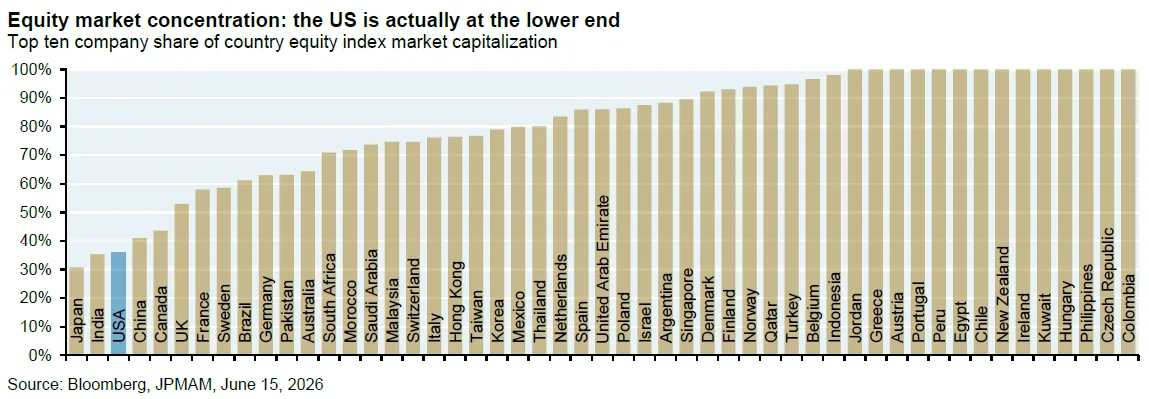
As noted last quarter, it remains premature to declare clear winners and losers in the AI transition; however, the Magnificent 7 companies have ceded leadership this year to other areas of the AI trade. Semiconductors have taken center stage, now representing a record 18.8% of the S&P 500 and 40% of the technology sector.xvi Overall, the S&P 500 is more concentrated than at any point since the technology bubble of the late-1990s, with the ten largest stocks making up almost 40% of the index’s total market capitalization.xvii This level of concentration poses a challenge for active managers who, as fiduciaries, must manage the portfolio risks associated with having so much capital allocated to such a small number of securities. However, as you can see in the chart below, the U.S. is not as top heavy as most other foreign markets. We find this to be important context; the U.S. market is not an outlier from a concentration perspective and should be less susceptible to large market swings tied to the fate of just a few companies.
Disciplined Positioning: Playing Both Offense and Defense
With markets again flirting with all-time highs, we have been working to keep equity allocations within a few percentage points of our investment targets, although this varies on an account-by-account basis depending on individual circumstances. We have been trimming small-cap holdings, where appropriate, as the category continues to outperform. Additionally, we have had a weather eye on the rebalance that occurred at the end of the quarter, when many of the AI winners graduated to other indices (e.g., Google’s inclusion in the Dow Jones Industrial Average). In fixed income, with markets now expecting interest rates to be higher for longer, we have had the opportunity to add bonds at attractive yields-to-maturity.
Final Whistle: Keeping the Long View
As the World Cup unfolds, billions of people from every corner of the globe will gather around televisions, stadiums, and public squares to celebrate a shared experience. Languages, cultures, and political differences will not disappear, but for a few weeks they become secondary to a common purpose.
Long-term investing operates under a similar principle. Markets often appear dominated by conflict, uncertainty, and short-term noise. Yet beneath those headlines lies more powerful forces: people building businesses, creating technologies, solving problems, and improving productivity. Those efforts continue regardless of election cycles, geopolitical disputes, or quarterly fluctuations. The objective isn’t to predict every move on the field, but to remain committed to a sound game plan – grounded in fundamentals, aligned with long-term goals, and resilient through changing conditions.
Amidst the noise, the lesson is simple: stay invested, stay disciplined, and keep your focus on the full match, not just the latest play. If your circumstances have changed, or if you have questions about how your portfolio is positioned, please do not hesitate to contact us.
Club Updates & Official Notices
A Special Message from Kirstie Martinez, COO
Please join me in congratulating our President, Brian Mackin, on his 25th anniversary with the company!
From our early days on Little River Turnpike in Annandale, to Beverly Road, and now to our offices in McLean, VA, and Rockville, MD – what an extraordinary journey it has been. Over the years, Brian has worn many hats: Equity Trader, Portfolio Manager, Relationship Manager, Chief Compliance Officer, Chief Operating Officer, and now President. Just as importantly, he has grown from a young professional into a devoted husband and father.
Over a quarter century building relationships with clients and colleagues, navigating both strong markets and challenging downturns, managing acquisitions and audits, Brian has remained a steady, thoughtful leader – with a consistent sense of humor that keeps us all grounded. I believe I speak for our staff and many of our clients when I say how fortunate we are to have Brian at the helm. He is a respected leader, a trusted partner, a source of practical wisdom, and a genuine friend.
Here’s to the journey so far – and to many more milestones ahead!
We have included our annual Privacy Notice with your report, outlining our policy regarding the confidentiality of client information. If you wish to opt out of information sharing, other than what is required by law, please complete the form used by our parent company, Atlantic Union Bank, at https://www.atlanticunionbank.com/privacy or call their toll-free number at 1-800-990-4828. Our current Privacy Notice is also available on our website at http://www.westfinancial.com/disclosures.
Follow us on LinkedIn or go to www.westfinancial.com to view our recent blog posts. Thank you for your continued confidence in West Financial, and please do not hesitate to refer your friends, family, or co-workers who may benefit from our services.
President
i https://www.wsj.com/livecoverage/stock-market-today-dow-sp-500-nasdaq-06-30-2026
iii Each of the S&P 500 Index, the S&P 400 Index, the S&P 600 Index, the MSCI EAFE Index, the ICE BofA 1-5 Year Index, the ICE BofA 1-10 Year Index, the ICE BofA 1-12 Year Municipal Bond Index, the Dow Jones Industrial Average, and the NASDAQ Composite (each, an “Index”) is an unmanaged index of securities that is used as a general measure of market performance. The performance of an Index is not reflective of the performance of any specific investment. Each Index comparison is provided for informational purposes only and should not be used as the basis for making an investment decision. Further, the performance of your account and each Index may not be comparable. There may be significant differences between the characteristics of your account and each Index, including, but not limited to, risk profile, liquidity, volatility and asset comparison. The performance shown for each Index reflects no adjustment for client additions or withdrawals, and no deduction for fees or expenses. Accordingly, comparisons against an Index may be of limited use. Investments cannot be made directly into an Index.
iv https://www.eia.gov/dnav/pet/hist/RWTCD.htm
vi https://www.atlantafed.org/research-and-data/data/gdpnow
vii https://www.bls.gov/news.release/pdf/cpi.pdf
viii https://www.bea.gov/data/personal-consumption-expenditures-price-index-excluding-food-and-energy
ix https://www.cnbc.com/2026/06/17/fed-interest-rate-decision-june-2026.html
xii https://www.federalreserve.gov/releases/h15/
xiii https://www.cmegroup.com/markets/interest-rates/cme-fedwatch-tool.html
xvii https://www.ubs.com/global/en/wealthmanagement/insights/marketnews/article.3471267.html
West Financial Services, Inc. (“WFS”) offers investment advisory services and is registered with the U.S. Securities and Exchange Commission (“SEC”). SEC registration does not constitute an endorsement of the firm by the SEC nor does it indicate that the firm has attained a particular level of skill or ability. You should carefully read and review all information provided by WFS, including Form ADV Part 1A, Part 2A brochure and all supplements, and Form CRS.
The information contained herein does not constitute investment advice or a recommendation for you to purchase or sell any specific security. You are solely responsible for reviewing the content and for any actions you take or choose not to take based on your review of such content.
This information is intended to be educational in nature, and not as a recommendation of any particular strategy, approach, product or concept. These materials are not intended as any form of substitute for individualized investment advice. The discussion is general in nature, and therefore not intended to recommend or endorse any asset class, security, or technical aspect of any security for the purpose of allowing a reader to use the approach on their own.
Certain information contained herein was derived from third party sources as indicated. While the information presented herein is believed to be reliable, no representation or warranty is made concerning the accuracy of any information presented. WFS has not and will not independently verify this information. Where such sources include opinions and projections, such opinions and projections should be ascribed only to the applicable third party source and not to WFS.
Certain statements herein reflect projections or opinions of future financial or economic performance. Such statements are “forward-looking statements” based on various assumptions, which may not prove to be correct. No representation or warranty can be given that the projections, opinions, or assumptions will prove to be accurate.